


Posted in:
Reciprocity Trust moves South Island Residents from Acknowledgment to Action
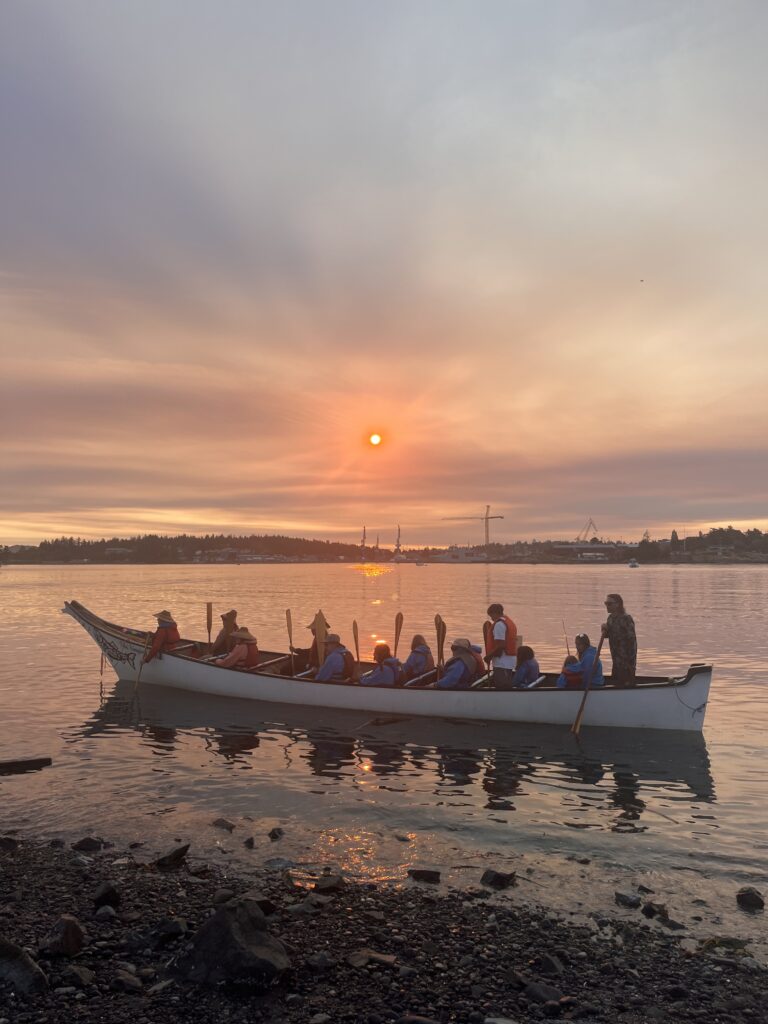
Xwsepsum (Esquimalt) Nation hosts a stopover for the Paddle To Elwha Canoe Journey, 2025. Photo: Dorothy Hodgins
Reciprocity Trust moves South Island Residents from Acknowledgment to Action
Story by Esther Tung
In southern Vancouver Island, daily life is deeply interconnected with its surrounding territories. For a home located in Victoria, tap water flows in from watersheds in the T’Souk-ke territory, while garbage is trucked out every week to a landfill on W̱SÁNEĆ lands. Victoria itself is on the traditional lands of the Lekwungen peoples of the Songhees and Esquimalt Nations, who have cared for these territories for countless generations.
Reciprocity Trusts is a nonprofit that offers settlers a way to honour and value these relationships and the local First Nations’ stewardship of the lands and waters. Residents and business owners can opt into an explicit and intentional process of wealth redistribution by contributing to a regional trust. Homeowners are invited to contribute the equivalent of 1% of their monthly property taxes and businesses 1% of their monthly revenue, though the amount is ultimately up to each contributor. Contributions to the trust are redistributed to the local First Nations.
Reciprocity Trusts launched its first regional trust, the South Island Indigenous Reciprocity Trust, in 2023. 10 Indigenous nations with core territory in what is known today as the Capital Regional District or Greater Victoria. Six of those nations have appointed a trustee to co-govern the trust.
Indigenous Nations in Greater Victoria
- T’Sou-ke Nation
- The Lək̓ʷəŋən people of the Esquimalt and Songhees Nations
- The WSÁNEĆ communities of W̱JOȽEȽP (Tsartlip), SȾÁUTW̱ (Tsawout) and W̱SIḴEM (Tseycum), MÁLEXEȽ (Malahat) and BOḰEĆEN (Pauquachin) First Nations
- Sc’ianew (Beecher Bay) First Nation
- Pacheedaht First Nation
The member nations of the South Island Indigenous Reciprocity Trust share the revenue equally, regardless of each nation’s population size, a gesture of naut’sa mawt, the Hul’q’umi’num’ phrase which means “one heart and mind.”
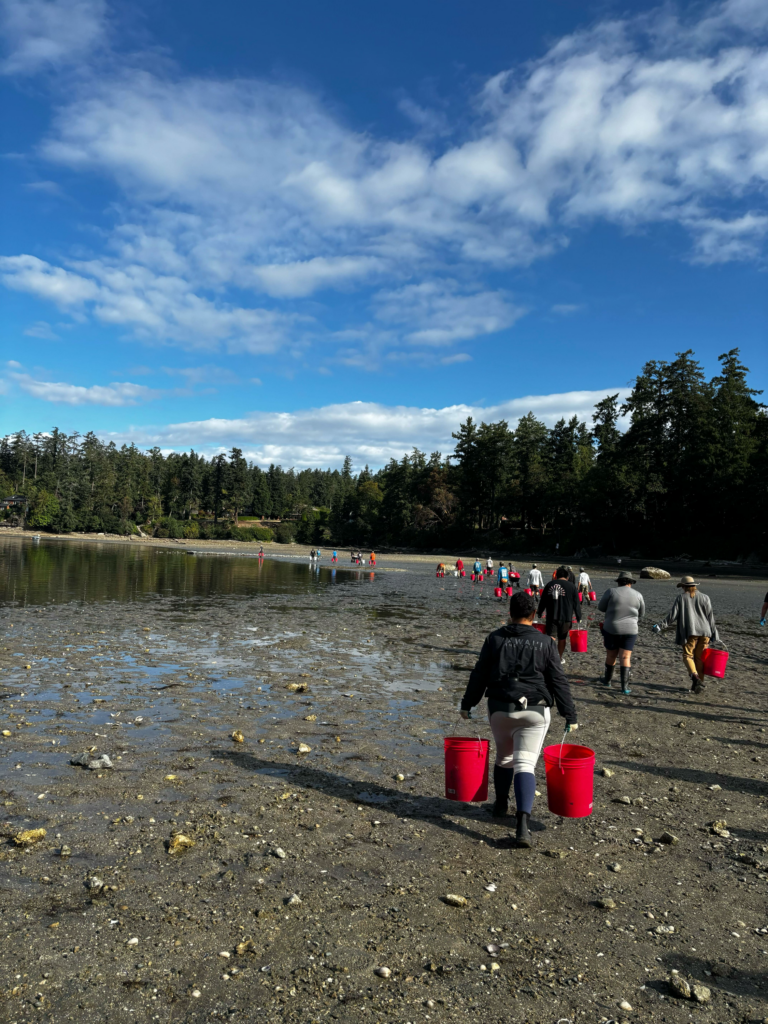
Since its inception, the trust has distributed approximately $15,000 to each of the ten local nations. The funds have been used for activities such as operating a Big House, vital cultural infrastructure for ceremony and gathering; and purchasing grocery gift cards for families to improve food security. The Tsawout Nation created a cultural capacity fund, supporting longhouse ceremonies, sports programs for youth, and participation in the annual Tribal Journeys canoe voyage.
In its first year, Reciprocity Trust raised just over $60,000 for the South Island trust from homeowners and businesses. Next year, that total doubled. To date, nearly 300 homes and businesses have joined, many renewing their support for another year and proudly displaying a r.trust decal to demonstrate their support. The potential size of the trust is enormous. Across the region, there are more than 170,000 privately owned dwellings, with an average value of $760,800.
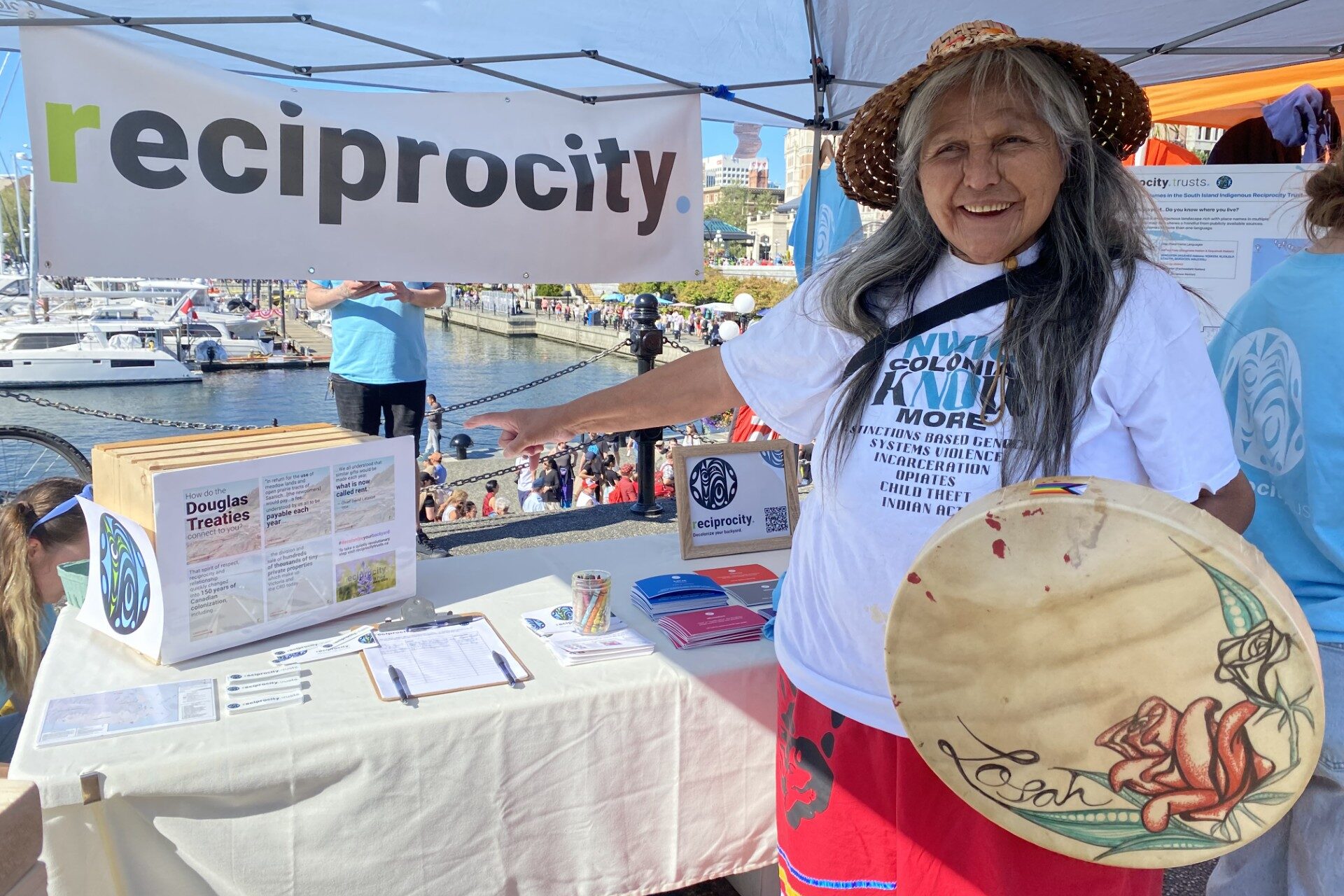
Tsawout Chief Abraham Pelkey, a trustee for the South Island Indigenous Reciprocity Trust, says, “The idea has been truly amazing: to build allyship with people outside our Nation, to help build capacity for our people, and to put the funds toward good initiatives. Our cultural practices need funding in real time, and this has helped offset a lot of costs so we can really uplift our people in a cultural way.”
“I want to see [the r.trust] decal in the window of my favourite coffee shop, to remind me that we are recognized,” he says. It’s why he was one of the first trustees to come on board. To him, it was a kind of relationship-building across cultures.
From the start, Reciprocity Trust aimed to prioritize Indigenous self-determination. The South Island Indigenous Reciprocity Trust relies on governing and beneficiary Nations to take the lead. “We simply could not exist without buy-in from Indigenous communities,” says Sarah Reid, the executive director of Reciprocity Trusts.
With the four remaining nations who have yet to appoint a trustee, Sarah notes that the door is always open for their involvement. She meets each spring with each nation’s executive staff with updates, who then pass on reports to the council as an opportunity for guidance and feedback.
“We’re moving at the pace of trust, and that looks different for every community,” says Sarah. This same approach is how they approach conversations with nations in other regions. Discussions are also underway with First Nations in the Lower Mainland and the Kootenays to establish regional trusts. No matter where the next trust launches, local Indigenous leaders will be at the helm.
Published on: January 2, 2026
SHARE